
Nikro Air Duct Cleaning in Sandy: A Homeowner’s Guide
Most homeowners shopping for duct cleaning ask about price first and equipment never. That’s backwards. Nikro doesn’t advertise to homeowners at all. They sell to restoration contractors and industrial facilities, which is exactly why a truck carrying Nikro equipment is a signal worth paying attention to. If you search “Nikro air duct cleaning Sandy UT,” you’re already asking the right question. This guide explains what the machines actually do, why the brand matters inside your home, and how to verify a contractor’s claim before you book.
If you’d rather skip the homework and talk to someone, call (833) 858-9278.
What Does Nikro Actually Make, and Why Does It Matter in Sandy?
Nikro Industries builds vacuum and agitation equipment to restoration-contractor specifications, not consumer specs. Their product lines are engineered for post-fire and flood remediation work, where containment isn’t optional. When that same equipment is used in residential air duct cleaning, it handles a Sandy home’s debris load differently than a shop vac with a hose adapter. Three product categories do most of the work:
- Portable HEPA vacuums. These are the workhorses. A HEPA filter captures particles at the 0.3-micron range, which covers dust, dander, mold spores, and the fine particulate that settles in ducts over years.
- Negative air machines. These create a pressure differential, pulling air (and debris) toward the collection point instead of letting it redistribute into living space.
- Duct cleaning systems. The agitation side, with brushes and air whips that break debris loose from duct walls so the vacuum can capture it.
Sandy’s housing stock runs from older split-levels built in the 1970s and 80s to newer builds up the benches, and each has its own dust profile. Older homes tend to have more settled debris in main trunks; newer tight construction can concentrate whatever’s inside. Either way, the equipment has to move material, not just stir it.
Why Does HEPA-Rated Containment at the Vacuum Stage Matter?
Because whatever the vacuum doesn’t capture ends up in your living room. A standard shop vacuum pulls duct debris through a basic filter and exhausts the rest into the air you’re standing in. A non-HEPA unit running on a Sandy job can liberate the same particulate it was hired to remove, and the homeowner breathes it for the next several hours. That’s the opposite of the service you paid for.
HEPA-rated containment at the vacuum stage changes the outcome. Debris gets pulled into a sealed collection system with a filter rated to trap microscopic particles. Professional crews pair that with air filtration from Abatement Technologies during the job for additional containment and cleaner results at the end. The practical test is simple: watch where the exhaust from the vacuum goes. If the machine is running in your hallway with no sealed connection to the duct system and no filtration running, that’s a signal. If the setup looks like a small industrial operation with hoses clamped to registers and a filtration unit humming in the corner, that’s closer to how the work should look.
Ask the contractor how the vacuum connects to the system, and whether the machine is HEPA-rated. It’s a fair question, and a professional will answer it without hesitation.
How Do Negative Air Machines Keep Debris From Redistributing?
They create a pressure differential, which is a fancy way of saying they pull air toward the collection point while the rest of the system seals off. Think of it as a controlled draft: the machine lowers pressure inside the duct run being cleaned, so loosened debris moves toward the vacuum rather than drifting out of nearby registers and into your living room.
The agitation tools (brushes, air whips) break material loose from duct walls. Without a pressure differential pulling in the right direction, that loosened material goes wherever air currents push it. With one, it flows toward collection. This sequencing is why a Nikro-equipped cleaning follows a method, not a scattershot approach. The crew sections off the system, sets negative pressure in the branch being worked, agitates, and captures. Then it moves to the next branch. In a Sandy split-level, that usually means working from the main trunk out to the branch runs, then repeating the process upstairs. The HVAC cleaning side extends coverage from the vent to the unit, so the air handler and coil don’t recontaminate clean ducts the first time the system kicks on.
What Questions Should You Ask a Contractor Claiming to Use Nikro Equipment?
You should ask to see the actual machine, not a photo of one. The brand claim is common; the machine is not always what shows up. Here’s what to ask before booking:
- “Can you show me the vacuum you’ll use?” Legitimate crews will describe the machine or show you on arrival. Vague answers are a flag.
- “Is it HEPA-rated?” The answer should be an immediate yes or no, not a pivot to a discount.
- “How does the vacuum connect to my system?” Sealed connection to a register or duct opening, not a loose hose sitting in the hallway.
- “What do you do about leaks you find?” Pure-cleaning companies spot leaks and hand you a business card for someone else. We repair what we find, because a sealed duct system holds the cleaning and improves efficiency.
- “Do you sanitize, and with what?” Guardsman-backed sanitizing protocols address mold, bacteria, and allergens after cleaning, which is a different service tier from debris removal alone.
- “What filter systems do you work with?” Compatibility with Honeywell and Aprilaire product lines means the cleaning connects to the right filtration upgrade rather than a guess.
A crew that answers all six in plain language is likely using the equipment they claim. A crew that gets defensive isn’t.
What Does a Nikro-Equipped Cleaning Look Like in a Sandy Split-Level?
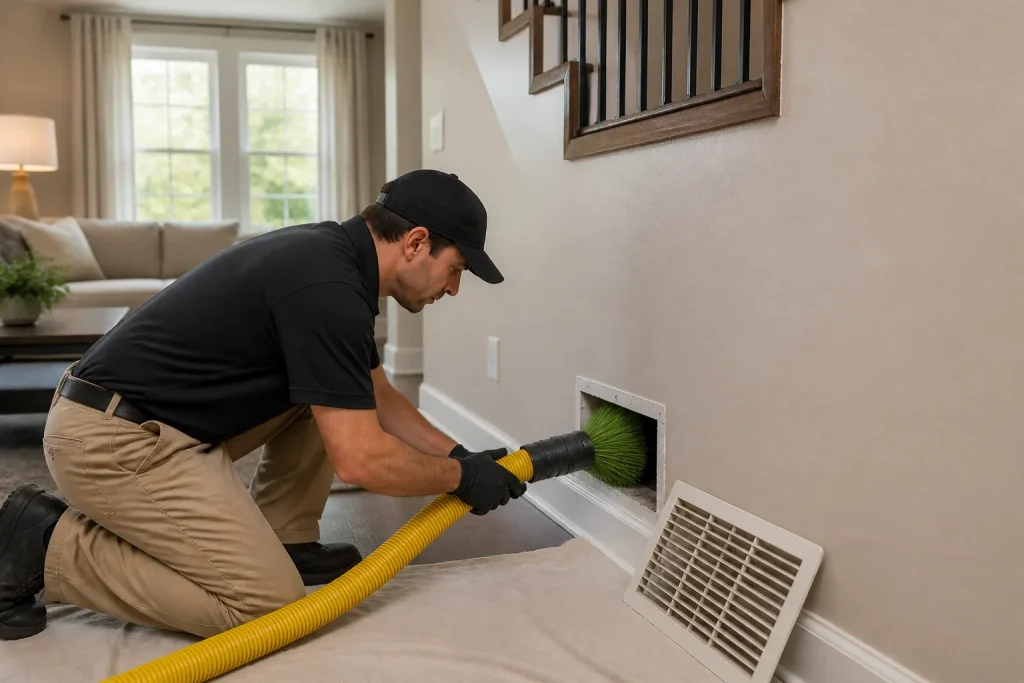
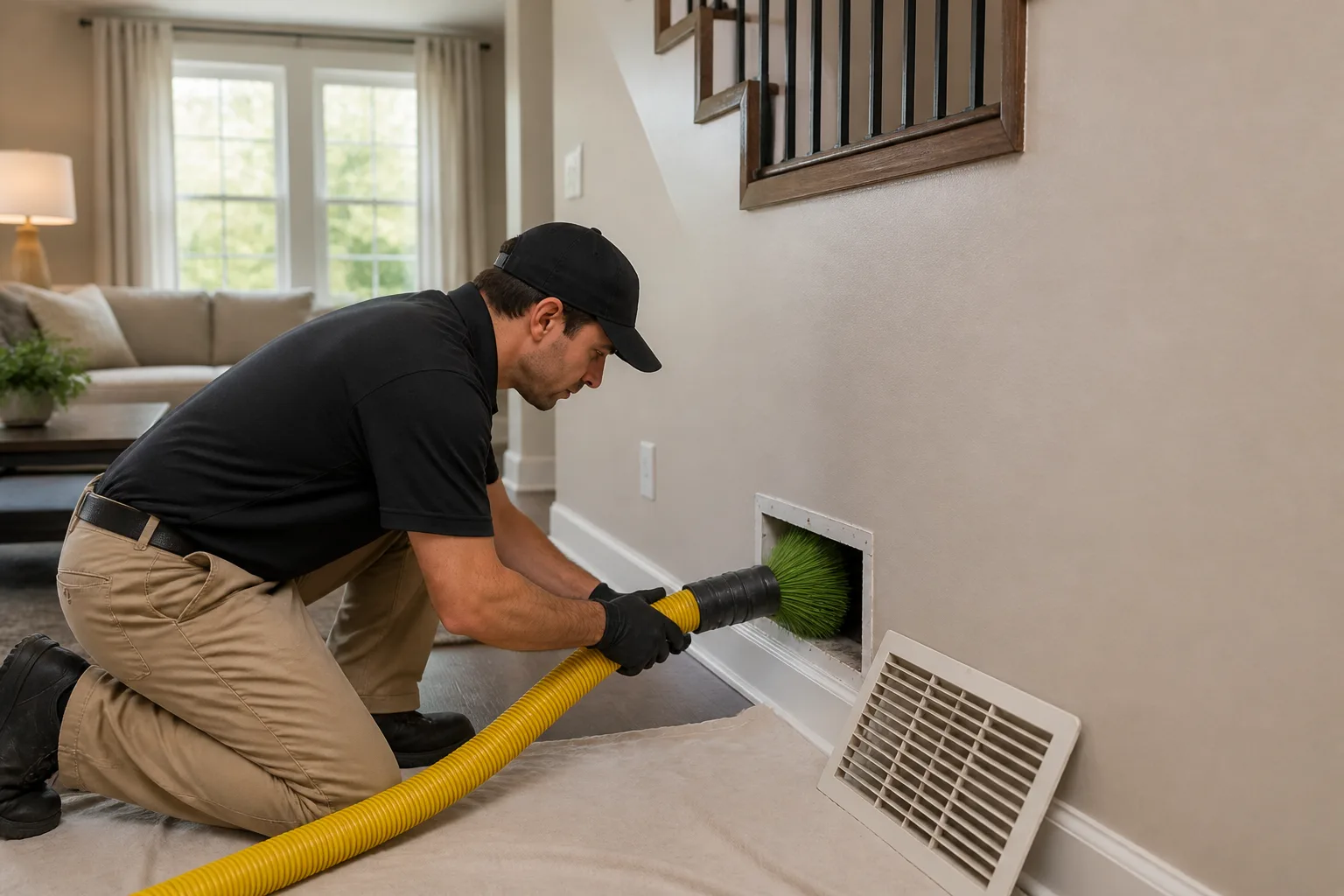
Picture a typical Sandy split-level, bedrooms upstairs, main living area at grade, and a finished basement. A crew with professional-grade equipment works the system in stages. First, they set up the HEPA vacuum and connect it to the main trunk access, then run filtration to contain airborne particulate during the job. Then they work branch by branch, upstairs bedrooms first, agitating with brushes and air whips while negative pressure pulls debris toward collection. The basement runs get the same treatment. If the crew finds separated joints or leaks in the dryer vent cleaning or supply runs, they note them and offer repair and sealing as the same-visit fix. After cleaning, sanitizing with Guardsman protocols is an option. Finally, before-and-after photos of your own ducts let you see what was actually removed.
Rotobrush equipment is often part of the same setup, and the combination is the point: professional-grade equipment, residential care. Our technicians have up to 15 years of experience, and we’ve seen enough Sandy systems to know a split-level isn’t the same job as a ranch with a full attic run.
When Should You Call a Pro Instead of Waiting?
Call when allergy flare-ups spike indoors, when a musty smell comes through the registers, when airflow is uneven room to room, or when energy bills climb without an obvious cause. Those are the four signals that actually point to duct problems. A monthly filter change handles the routine dust load; it doesn’t address debris settled in the trunks. If the smell persists or someone in the house reacts more indoors than out, it’s worth a professional diagnosis rather than another filter swap.
Related services in Sandy: we handle dryer vent cleaning and full-system air quality work alongside duct cleaning, so a single visit can address the airflow chain from vent to unit.
The Bottom Line
Nikro equipment matters because it was built for restoration work, and that engineering shows up in how much debris actually leaves your duct system versus ends up in your air. Ask to see the machine, ask about HEPA rating, and ask what happens if leaks turn up. The answers will separate a professional operation from a coupon-driven crew. If you’re in Sandy and want those questions answered by someone who uses the equipment daily, Sandy Air Duct Cleaning Pros offers free estimates and works from a written, per-job price agreed before any work starts. Call (833) 858-9278. We answer 24/7. Fast dispatch from 7am to 7pm, Sunday through Friday.
Frequently Asked Questions
Pricing depends on the size and layout of the system, so we quote per job instead of per vent. The written estimate sets the final price, and it’s agreed before work starts so there’s no surprise invoice later. Call (833) 858-9278 for an exact quote – estimates are free.
Ask to see the vacuum and confirm it’s HEPA-rated. Legitimate crews describe the machine in plain terms and show it on arrival; a sealed connection to your duct system and a separate filtration unit running during the job are both signs the setup is professional-grade. If the answers are vague, keep shopping.
Most homes don’t need it on a fixed schedule. Visible debris at the registers, persistent musty odors, uneven airflow, and allergy symptoms that worsen indoors are the triggers worth acting on. If none of those apply, a filter change and a duct inspection once in a while is usually enough.
Cheaper quotes usually reflect consumer-grade vacuums without HEPA filtration, or a per-vent price that grows once the crew is on site. The equipment is where the cost difference lives, and it’s also where the result lives. Ask what machine is coming to your house before you compare numbers. Call (833) 858-9278 to talk through your system – estimates are free.
Written by the team at Sandy Air Duct Cleaning Pros.
Need Air Duct Cleaning Help?
Call Sandy Air Duct Cleaning Pros - the local pro we connect you with is licensed and insured, with free written estimates in Sandy.
(833) 858-9278