
Air Duct Cleaning: Repair or Replace? How Sandy Homeowners Decide
Here’s a mistake we see more than any other: a homeowner books a cleaning on flex duct that was already failing, the agitation brush does its work, and the liner starts delaminating before the technician packs up. Cleaning deteriorating flex is a lot like washing a mesh bag with holes in it. The dirt leaves, and so does the structural integrity. In Sandy, that decision usually comes down to duct material, where the breach sits, and whether the contamination source is actually gone – not how old the system is. If you’d rather not sort that out alone, call (833) 858-9278.
Key Takeaways
- Duct material (sheet metal, flex, fiberglass-lined) drives the repair-or-replace call more than age does.
- Cleaning can’t fix ductwork that’s already failing structurally.
- Contamination sources have to be resolved before any cleaning makes sense.
- A scope-of-work document should list exact sections, access method, and expected outcome.
How do you tell during a cleaning whether ducts are failing?
Deterioration shows up in specific, checkable ways, and a trained eye catches it while the system is open. In Sandy’s 1980s-to-2000s housing stock, the telltales are fairly predictable once you know what to look for. The point of looking is simple: if the ducts are failing, cleaning is money spent on a system that will just re-contaminate.
- Delaminated flex liner. The inner lining peels away from the outer jacket and collapses inward, choking airflow and trapping debris in the gap. Once it’s separated, no amount of cleaning puts it back.
- Disconnected sections. Flex runs come apart at joints, especially in attics and crawlspaces where they take heat and movement. A disconnected run dumps conditioned air into the attic instead of your rooms.
- Mastic failure. The sealant at seams cracks and pulls away, opening gaps that leak air and invite dust back in. Cleaning a system with failing mastic is a temporary win at best.
- Crushed or kinked runs. Flex that’s been stepped on or pinched in a tight run restricts flow and can’t be cleaned effectively.
What a technician should do is document each finding – photos, location, and severity – then tell you plainly whether a targeted repair will hold or whether the run needs replacing. With professional-grade Rotobrush equipment and Abatement Technologies filtration in the mix, containment matters too: you don’t want debris from a failing run spread through the rest of the house mid-job. A thorough air duct cleaning in Sandy starts with this kind of inspection, not with a brush in the first vent.
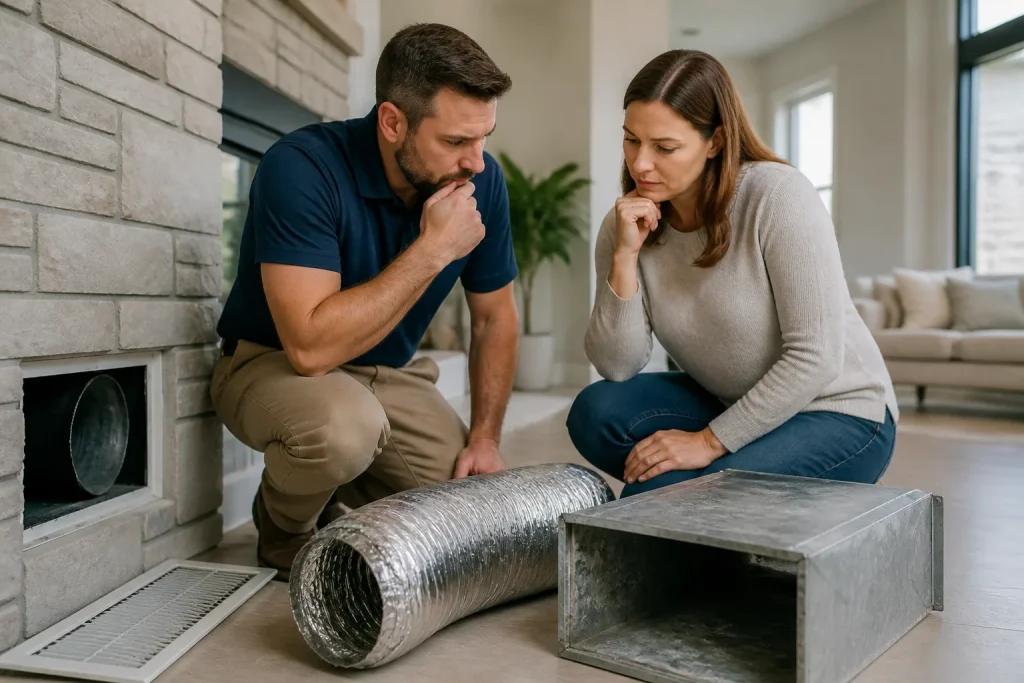
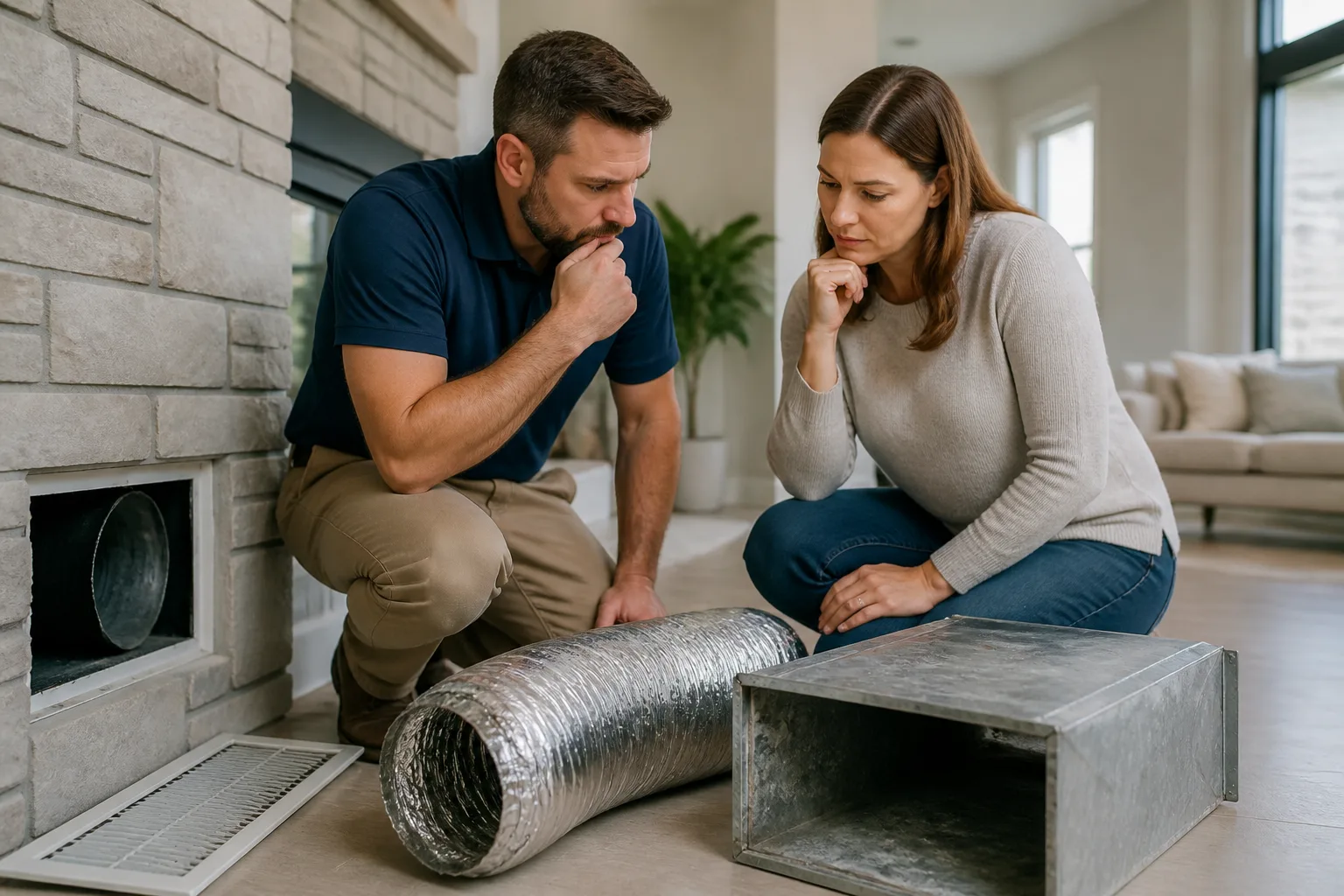
Sheet metal vs. flex vs. fiberglass: which decision applies to your Sandy home?
Each duct material fails differently, so each has its own threshold where cleaning stops being worth it. Knowing which one you have tells you a lot about what to expect.
- Sheet metal ducts are the most repairable. They don’t delaminate, so cleaning usually works. Failures are seam and joint related – resealing with mastic or tape is a targeted fix, not a full replacement.
- Flex duct is the most fragile. The inner liner is the weak point. Marginal flex can survive cleaning; flex with an already-compromised liner often shouldn’t be cleaned at all, because agitation accelerates the breakdown.
- Fiberglass-lined duct traps debris in the lining’s texture. Light contamination cleans up, but heavy buildup or damaged lining means the duct can’t be restored by cleaning alone.
In Sandy, where a lot of homes were built through the 1980s, ’90s, and early 2000s, flex is common in attic runs while the main trunk is often sheet metal. That mixed setup matters: you can repair or replace individual runs without touching the whole system. A reputable contractor should identify each material, section by section, before recommending anything.
What does repair vs. replace actually cost in the Sandy market?
Cost is where most homeowners get stuck, so here’s the honest framing. In the Sandy market, a full flex duct replacement in a 2,000 sq ft home is a significant project – typically the larger line item by far. A cleaning plus targeted repair of a few runs sits well below that. Repeated cleanings on deteriorating ductwork are the worst outcome: you pay again and again and the system never gets healthier. The written estimate sets the final number.
| Option | What it involves | When it makes sense |
|---|---|---|
| Cleaning only | Full-system cleaning with professional equipment | Ducts are sound; contamination is surface-level |
| Cleaning + targeted repair | Cleaning plus resealing joints or replacing a few failing runs | Most of the system is sound; a few sections are compromised |
| Full replacement | New flex runs for failing sections or the whole system | Widespread delamination or disconnected runs throughout |
The key insight: most Sandy homes don’t need all-or-nothing. Targeted repair is usually the better spend when only some runs are failing. Ask for line-item ranges, not a lump sum, so you can see exactly what each part of the work costs. If you want to understand what the cleaning portion covers first, our HVAC cleaning page walks through the whole airflow system. And our team at Sandy Air Duct Cleaning Pros is glad to put numbers to your specific setup.
Why does cleaning make no sense until the contamination source is gone?
Because cleaning removes debris, not the reason debris keeps showing up. If something is still feeding the problem, fresh contamination returns within weeks. That’s the contamination-source rule, and it saves homeowners from wasting money. The most common sources in Sandy homes are animal intrusion in attic flex, water intrusion that leaves damp debris behind, and an HVAC malfunction that keeps pushing particles through the system.
Here’s how to confirm the source is eliminated before you spend on cleaning or replacement:
- The animal problem is gone – no droppings, no nesting material, entry points sealed.
- Any water intrusion is fixed and the area has dried out.
- The HVAC unit is running correctly and not throwing dust or moisture downstream.
Only then does dryer vent cleaning or duct work pay off as intended – the same discipline applies to the dryer vent, where lint buildup is a separate and serious safety risk. Guardsman sanitizing protocols help with residual mold and bacteria, but sanitizing isn’t a substitute for fixing the source. Clean over an active problem and you’re paying to do it twice.
What should a scope-of-work document include before you approve replacement?
A recommended replacement should come with a written scope that you can hold a contractor to. Vague “we’ll redo the ducts” is a red flag. A solid scope lets you compare cleaning-only against repair against replacement and see the outcome you’re paying for. Ask for these in writing:
- Specific duct sections – which runs, in which rooms, replaced or sealed.
- Access method – where they’ll cut in and how they’ll reach attic or crawlspace runs.
- Expected outcome – better airflow in named rooms, sealed joints, leak-tested result.
- What stays – which existing ductwork is being kept, so you’re not paying to replace sound sections.
- Verification step – how they’ll confirm the work fixed the problem, not just that it’s done.
Our repair-and-sealing capability matters here: we repair what we find rather than only cleaning and leaving failing runs behind. Working with Honeywell and Aprilaire filtration lines means we can also connect cleaning to upgrades you recognize by name. Get the scope first, approve second.
When should you call in a pro instead of guessing?
If you can’t see inside the system, can’t tell flex from fiberglass, or smell something musty that keeps coming back, that’s your cue. A trained technician with professional-grade equipment can open the system, document the condition, and tell you truthfully whether cleaning will hold. And if a run is failing, we can repair or replace it in the same visit. Same-day help is often possible. Call (833) 858-9278. We answer 24/7. Fast dispatch from 7am to 7pm, Sunday through Friday.
The Bottom Line
Repair or replace isn’t a matter of age. It’s duct material, where the breach is, and whether the contamination source has been eliminated. Most Sandy homes with a few failing runs are better served by cleaning plus targeted repair than by a full replacement, and repeated cleanings on failing ductwork are the option to avoid. Get a written scope, insist on material-specific reasoning, and confirm the source is gone before any work begins.
If you’re in Sandy and need help, Sandy Air Duct Cleaning Pros offers free estimates – call (833) 858-9278. Our technicians have up to 15 years of experience, and the local pro is licensed and insured as their state requires.
Frequently Asked Questions
No. You usually only replace the failing sections and reseal the rest. In a mixed system, individual flex runs can be replaced without touching the main trunk or sound sections. Ask for a scope that lists exactly what stays.
Yes, sometimes. Agitation can accelerate liner delamination in duct that was already marginal. That’s why a technician should inspect and document material condition before cleaning, not after.
Confirm no animals, no water intrusion, and a functioning HVAC unit first. Cleaning over an active source just brings the debris back. Call (833) 858-9278 for a free estimate once you’ve checked these.
It varies with the home – animals, water issues, and contamination can all trigger it sooner. There’s no single rule that fits every Sandy house, so ask about your specific system rather than a fixed schedule.
A low all-in number usually skips inspection, containment, or the repair that a failing run needs. Cleaning near a failing run without fixing it leaves you right back where you started. Call (833) 858-9278 for an honest estimate – estimates are free.
Ask for before-and-after photos of your own ducts and a written scope you can check against the result. A reputable contractor documents what was cleaned and what was repaired. We handle the full airflow chain, so get it confirmed in writing.
Written by the team at Sandy Air Duct Cleaning Pros.
Need Air Duct Cleaning Help?
Call Sandy Air Duct Cleaning Pros - the local pro we connect you with is licensed and insured, with free written estimates in Sandy.
(833) 858-9278